All published articles of this journal are available on ScienceDirect.

Role of Organizational Support on Interpersonal Communication, Innovative Work Behaviour and Performance: A Study of Small IT Enterprises

Abstract
Introduction
The present study was conducted in the IT sector on small-scale web development enterprises in Northern India. This study aimed to elucidate the moderating effect of Organizational Support (OS) on the mediating role of Innovative Work Behaviour (IWB) between Interpersonal Communication (IPC) and Performance (P).
Materials and Methods
The study sample comprised 246 web developers from 20 small-scale enterprises. The participants were selected by applying a simple random sampling technique. The study used four standardized scales to collect data on the variables. The data was analysed by using PLS-SEM.
Results
The analysis showed that innovative work behaviour mediated interpersonal communication and perceived performance. Furthermore, this mediating effect became conditional upon the level of organizational support.
Discussion
The results demonstrate that organizational support is a crucial variable in the model. The study enhances understanding of the relationship among innovative work behaviour, interpersonal communication, and performance. The moderating role of organisational support in this model makes this study distinctive and significant for future research.
Conclusion
The present study synchronizes the relationship between interpersonal communication, innovative work behaviour, performance, and organisational support. The study concluded that innovative work behaviour mediated the relationship between interpersonal communication and performance. Moreover, this indirect relationship is conditional. The study concluded that organisational support is a game-changer in the triad relationship of interpersonal communication, innovative work behaviour, and performance.
1. INTRODUCTION
Multiple factors contribute to an organization's success, including Organizational Support (OS), Interpersonal Communication (IPC), Innovative Work Behaviour (IWB), and performance. OS is defined as the consideration for employees' welfare and well-being. Eisenberger et al. [1] assert that OS pertains to employees' perceptions of their care and well-being, which fosters positive employee behaviour. Sabir et al. [2] characterized OS as an employee's perception of being valued and having their needs acknowledged. Several studies have highlighted the impact of OS on performance. Akcin et al. [3] and Abou-Moghli [4] found that OS positively influences performance, with enhanced employee outcomes resulting from strong organizational support. Interpersonal Communication (IPC) is pivotal within organizational structures, as exchanging information and collaboration foster IWB. Hao et al. [5] characterized communication channels as offering solutions to problems, while Zhang et al. [6] associated IWB with creating novel ideas and solutions. IWB is crucial in driving organizational performance, as it facilitates the development and dissemination of innovative ideas. Ma Prieto and Pérez-Santana [7] identified a correlation between IWB and human resource practices that enhance employee opportunities. Similarly, Fath and Radikun [8] explained the association between employee conduct and creativity, reinforcing the significance of IWB in organizational success. Ultimately, performance is contingent upon OS, IPC, and IWB, and employee retention is a crucial determinant of organizational success [9, 10]. Van Dooren and Bouckaert [10] described performance as an efficient means by which employees accomplish job responsibilities to attain organizational objectives, while Pandey [9] characterized it as a multifaceted construct.
This study aims to explain the mediating effect of IWB on the relationship between IPC and performance and investigate the moderating effect of OS on the relationship between IPC and IWB. To our knowledge, no study has examined the moderated and mediating relationships between these variables. Furthermore, there was a knowledge gap in the relationship between the IPC and IWB regarding bounded conditions. Although various studies have been conducted in the IT sector, there is a lack of behavioural studies on small-scale firms; the present study aimed to fill these research gaps.
1.1. Context of Study
Over the last decade, India's IT sector has grown [11]. The context of the present study comprised web development enterprises in the IT sector. The number of firms related to web development was increasing exponentially to meet the diverse digital needs of the economy. Such firms are crucial in India's digital transformation. These firms are working on a small scale but are producing significant employment [12]. These firms offer a range of services, including website development and digital solutions, to address various business problems. The number of such start-ups has increased significantly [13]. Balboa et al. [12] highlighted that these firms contribute to economic growth, job creation, and innovation. These small firms are registered under various MSME central and state laws, especially those under government schemes [14]. This business also contributes to exports, innovation, and social and economic development [15].
1.2. Literature Review and Hypotheses Development
IPC has a strong relationship with performance [16, 17]. Positive communication between employees leads to improved performance. In other words, a high level of IPC in the organization leads to excellent performance. Hao et al. [5] found that good organizational communication contributes to problem-solving and effective performance. Based on this discussion, the following hypothesis was made:
H1: IPC would have an effect on P.
Interpersonal communication plays an important role in an organization [18, 19]. It is associated with the creation, sharing, and exchange of knowledge, whereas Innovative Work Behaviour (IWB) involves the generation of new ideas and information. Previous research has identified a positive relationship between IPC and IWB, suggesting that organizations with higher levels of IPC tend to foster greater creativity [20-22]. Based on the existing literature, the following hypothesis was proposed:
H2: IPC would have an effect on IWB.
Innovative Work Behaviour (IWB) is a significant factor in organizational settings [23]. Organizations expect their employees to be innovative [24], as IWB is associated with generating new ideas to improve performance [23]. Various factors, including IWB and employee engagement, influence employee performance [25]. Previous studies have demonstrated that IWB positively influences employee performance, alongside other factors such as employee engagement [23, 25]. Based on this discussion, the following hypothesis was proposed:
H3: IWB would have an effect on P.
Previous literature has identified a relationship between IPC and IWB [26], while studies have also demonstrated a positive association between IWB and P [23]. These findings suggest that IPC promotes IWB, which, in turn, enhances performance. Accordingly, several studies have reported that IWB mediates the relationship between IPC and P [26-28]. Based on this discussion, the following hypothesis was proposed:
H4: IWB would have a mediation effect on the relationship between IPC and P.
Organizational support positively affects innovative work behaviour for workers [6, 29, 30]. A higher perception of OS has been associated with greater innovative work behaviour [31]. Moreover, OS plays an important role in shaping employees' attitudes toward creativity and is linked to employee well-being and productivity [32]. Therefore, this discussion indicates that Organizational Support (OS) is an important factor for innovation.
H5: OS would have an effect on IWB.
Perceived organizational support is a significant variable. The literature revealed that OS influences the relationship between IPC and IWB [30]. It showed that this relationship's magnitude can change with low or high perceived levels of organizational support, a notion supported by previous literature [31]. Various researchers have studied the contingent effect of OS on variables related to IWB [32]. Conversely, various studies found that IWB is positively linked with performance [23-25]. It is expected that the moderating effect of Organizational Support (OS) on the relationship between Interpersonal Communication (IPC) and Innovative Work Behaviour (IWB) will influence the mediating role of IPC, IWB, and Performance (P). Based on this discussion, the following hypotheses were made:
H6: OS would moderate the relationship between IPC and IWB.
H7: OS would moderate the mediation between IPC and P through IWB.
1.3. Theoretical Foundation of the Study
Social Exchange Theory and Job Demands and Resources Theory supported the study's conceptual model as presented in Fig. (1). The implication of the theory is discussed below.
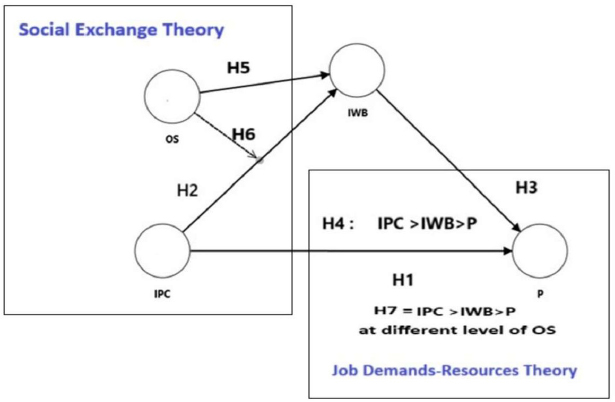
Conceptual and theoretical framework.
1.3.1. Social Exchange Theory
Social exchange theory shows that social behaviour results from exchange processes [33]. According to this, people interact with each other for social rewards and to minimize social costs. Interpersonal Communication (IPC) facilitates knowledge sharing and promotes innovation [33], while Organizational Support (OS) fosters a sense of obligation among employees to engage in Innovative Work Behaviour (IWB) in return [30]. Thus, social exchange through communication can lead to innovation within organizations, and OS may strengthen this relationship [33]. Overall, this theory supports the model's H2, H5, and H6.
1.3.2. Job Demands and Resources Theory
Job demands and resources theory also aligns with the model. According to this theory, a job has demands and resources [19, 28]. Job demands refer to the skills, as well as the psychological and physical effort required to perform a job, whereas job resources refer to organizational support that facilitates work and enhances performance. Good communication skills and an innovative work environment are considered aspects of job resources. Without organizational support, producing such an innovative work environment becomes difficult. In this way, H1, H3, H4, and H7 are supported by our model.
2. MATERIALS AND METHODS
2.1. Sampling Design
The study used a descriptive research design and was conducted in Northern India's IT industry. The sample unit of the study comprised web developers from various small, medium, and large firms operating in the business sector; however, the present study was conducted in small enterprises. In the first stage, a list of various firms was made. In the next stage, 20 firms confirmed their willingness to participate in the questionnaire survey. The respondents were selected using a simple random sampling method from the lists of employees at these 20 firms. The study sample comprised 246 web developers (Male = 137 and female = 109). From each firm, approximately 40% of respondents were selected. The total sample was approximately 20 per cent of these 20 firms. Furthermore, the sample size was confirmed using the Chohan sample size table, as mentioned in Hair et al. [34]. According to this table, when three arrows are assigned to the dependent variable to obtain a minimum R2 at 80% power, the suggested sample size is 156. Thus, the sample size is sufficient to run the model and is further supported by the ten-times rule, indicating that it is appropriate for the analysis.
2.2. Scales and Constructs
Four standardised scales were used to collect information regarding variables. The information regarding IPC was collected using the Campbell and Akdemir [35] scale. This scale has two dimensions, viz., external perception and external disseverance. The external perception contains four items, and external disseverance includes three items. Information regarding OS is collected using the five-item scale developed by Eisenberger et al. [1]. Responses regarding innovative work behaviour were collected using the six-item scale developed by Scott & Bruce [36]. Perceived performance data were collected using 9-item scales developed by Goodman and Svyantek [37]. The data were collected on a 5-point Likert scale. All the items were reflective (Appendix).
2.3. Procedure and Settings
The study was conducted in general settings, and the data were collected by using an online form. Initially, the manager was contacted by telephone, and with his permission, the questionnaire was then distributed to their groups. Furthermore, assistance from various research scholars was obtained for data collection.
3. RESULTS
3.1. Data Characteristics
After data collection, the data were cleaned and validated following the procedure used by Hair et al [34]. Initially, 350 questionnaires were sent, of which data were obtained from 270 participants, yielding a response rate of 70 per cent. The collected data contained no missing values as the questionnaire was customized. In the next stage, 20 cases with zero variance were identified, and their unengaged responses were removed. Descriptive statistics were applied to the remaining data to understand its nature. Subsequently, the multivariate normality of the data was examined using Rayston’s test and Q-Q plot. It was found that the data were not multivariate normal; hence, Partial Least Squares (PLS-SEM) was considered an appropriate analytical approach in this context. PLS-SEM is a variance-based, non-parametric technique that does not assume data normality or large sample sizes. In this study, data were analyzed using SmartPLS 4.0.
3.2. Measurement Model
Evaluation of both the measurement and structural models is important in SEM. Table 1 presents the results of the measurement model, which assesses construct reliability and validity. Convergent validity was evaluated using the Average Variance Extracted (AVE), with values greater than 0.50 indicating acceptable convergent validity. All constructs exceeded this threshold. Composite reliability (CR) was then assessed, with values above 0.70 considered acceptable [38], and all constructs met this criterion. Reliability was further confirmed using Cronbach's alpha, for which values greater than 0.70 indicate satisfactory reliability. Indicator reliability was also evaluated, with all indicator loadings exceeding the recommended threshold of 0.70.
| Indicators | λ | AVE | CR | α | HTMT Ratio |
|---|---|---|---|---|---|
| IPC1 | 0.828 | 0.74 | 0.919 | 0.883 | IPC > IWB =0.36 IPC > P = 0.73 IPC > OS = 0.56 |
| IPC2 | 0.872 | ||||
| IPC3 | 0.903 | ||||
| IPC4 | 0.835 | ||||
| IWB1 | 0.909 | 0.818 | 0.947 | 0.926 | IWB > IPC =0.36 IWB > OS = 0.56 IWB > P = 0.73 |
| IWB2 | 0.905 | ||||
| IWB5 | 0.928 | ||||
| IWB6 | 0.875 | ||||
| OS1 | 0.896 | 0.822 | 0.949 | 0.927 | OS > IPC =0.56 OS > P = 0.84 OS > IWB = 0.56 |
| OS2 | 0.948 | ||||
| OS3 | 0.935 | ||||
| OS5 | 0.845 | ||||
| P2 | 0.767 | 0.605 | 0.884 | 0.837 |
P > IPC =0.73 P> IWB = 0.52 P >OS = 0.84 |
| P3 | 0.754 | ||||
| P4 | 0.787 | ||||
| P6 | 0.826 | ||||
| P7 | 0.751 |
The result indicates that every item in the construct has a loading value greater than 0.70, indicating the construct's reliability. Here, it is necessary to mention that various items of constructs were removed due to non-significant loadings. The external dissimilarity dimension of IPC was removed because the loadings for 2 of 3 items were non-significant. IPC was performed with only one dimension. Next, the HTMT criteria were used to check the discriminant validity of the construct. These criteria say that the HTMT value between the constructs should be less than 0.85 [39]. Table 1 shows that all constructs have an HTMT value of 0.85, indicating discriminant validity.
3.3. Structural Model
The evaluation of the structural model followed the analysis of the measurement model. It is related to the path coefficients, R-Square, and effect sizes (Table 2). First, the results indicate that the effect of IPC on IWB was significant (β = 0.166, p < 0.05), underscoring a positive effect. IWB significantly affected performance (β = 0.284, p < 0.001); OS significantly affected IWB (β = 0.462, p < 0.001). The indirect effect of IPC on P through IWB was also significant (β = 0.047, p < 0.05). These results ensure that there was mediation of IWB in the relationship between IPC and P (Fig. 2). Furthermore, the interaction effect of OS and IPC was also significant (β = 0.14, p < 0.05). Figure 3 shows the slope between IPC and IWB at different levels of OS, which exhibits moderation in the actual way. These results empirically support H1, H2, H3, H4, H5 and H6.
| Paths | β | T statistics | P-values | VIF |
|---|---|---|---|---|
| IPC -> IWB | 0.166 | 2.368 | 0.018 | 1.34 |
| IPC -> P | 0.55 | 8.548 | 0 | 1.11 |
| IWB -> P | 0.284 | 4.81 | 0 | 1.11 |
| OS -> IWB | 0.462 | 5.955 | 0 | 1.55 |
| OS x IPC -> IWB | 0.14 | 2.04 | 0.041 | 1.31 |
| IPC -> IWB -> P | 0.047 | 2.066 | 0.039 | - |
| OS x IPC -> IWB -> P | 0.04 | 0.039 | 0.02 | - |
| IPC -> IWB -> P OS at +1 SD | 0.087 | 3.284 | 0.001 | - |
| IPC -> IWB -> P OS at Mean | 0.047 | 2.066 | 0.039 | - |
| IPC -> IWB -> P OS at -1 SD | 0.007 | 0.216 | 0.829 | - |
| N =246 | ||||
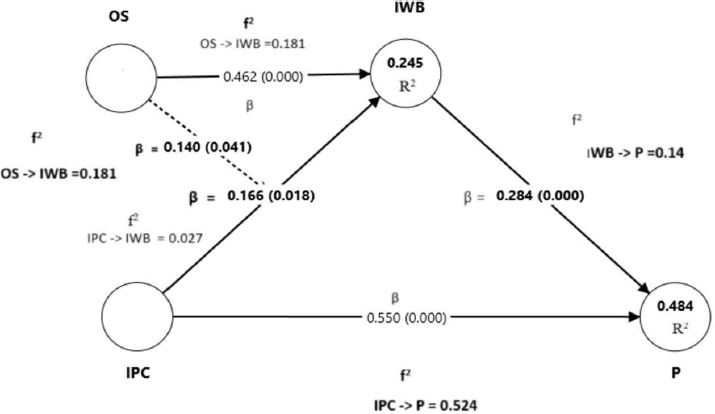
Empirically tested model.
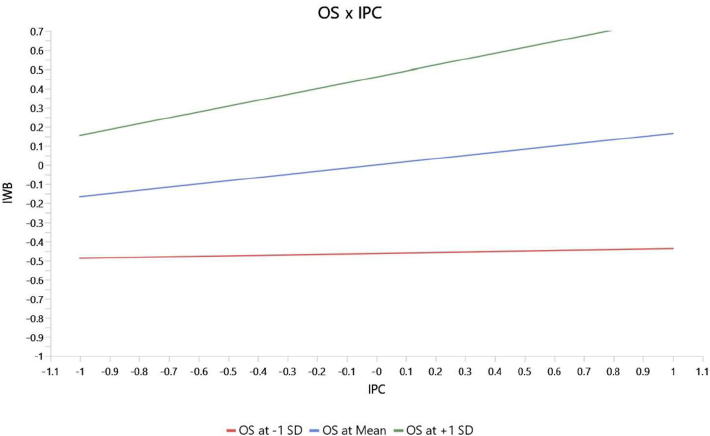
Moderation effect of organisational support.
3.4. Moderated Mediation
Table 2 also presents the result of moderated mediation. As per results, the mediation in the model is moderated (OS x IPC -> IWB -> P = 0.04, P < 0.05). Moreover, it shows that the indirect effect of IPC on P through IWB is conditional on OS. At higher levels of OS (β = 0.087, p < 0.01), the indirect effect is highly significant. However, at the mean level of OS (β = 0.047, p < 0.05), this indirect effect remains significant, and the path coefficient declines. At lower levels of OS (β = 0.007, p = 0.829), the magnitude of the path coefficient becomes extremely low and non-significant. These results confirm that as OS levels increase from lower to higher, the magnitude of the indirect effect changes significantly, thereby providing empirical support for H7. The model provided substantial evidence of moderated mediation.
Furthermore, the results (Fig. 2) show that IPC and OS explained 24% of the variance in IWB. Additionally, IPC and IWB in the model explained 48% of the variance in performance. The findings indicate that IPC had a small effect size on IWB and a large effect size on performance. OS exhibited a medium-to-large effect size on IWB, whereas IWB has a large effect size on performance.
3.5. Multicollinearity and CMB
Furthermore, we examined multicollinearity in the inner model using VIF values. It indicated that all VIF values were lower than 5 [38], suggesting that the model has no multicollinearity problem. We also examined the Common Method Bias (CMB) using the full collinearity VIF value, which was also less than 3.3. The results show that if the full collinearity VIF is less than 3.3, it indicates that the data are not affected by CMB.
3.6. Predictive Relevance of Model
The predictive performance of the model was examined as per guidelines. According to the guidelines of Shmueli et al. [40], the sample was first distributed into holdout and training samples for cross-validation. As per the procedure, the sample was split into different folds (K = 14), and PLS and LM (Linear Regression Model) were compared. The analysis provides various values, as shown in Table 3. According to the results, the Q2 values for both endogenous constructs were 0.20 and 0.48. The results indicate that IWB has medium to large predictive capability, and the performance variable has greater predictive capability. The indicator-wise summary reflects that most of the indicators of exogenous variables have lower RMSE and MAE. These results confirm that the model carries substantial predictive performance.
| - | Q2predict | RMSE | MAE | - | - |
|---|---|---|---|---|---|
| IWB | 0.203 | 0.906 | 0.626 | - | - |
| P | 0.484 | 0.726 | 0.522 | - | - |
| - | Q2predict | PLS-SEM_RMSE | PLS-SEM_MAE | LM_RMSE | LM_MAE |
| ICR5 | 0.141 | 1.038 | 0.765 | 1.04 | 0.779 |
| ICR7 | 0.213 | 1.113 | 0.824 | 1.088 | 0.802 |
| ISR1 | 0.137 | 1.003 | 0.738 | 1.019 | 0.753 |
| ISR2 | 0.152 | 0.944 | 0.703 | 0.931 | 0.696 |
| FD2 | 0.38 | 1.332 | 1.043 | 1.354 | 1.124 |
| PBC3 | 0.32 | 1.132 | 0.808 | 1.263 | 0.932 |
| PBC4 | 0.245 | 1.126 | 0.835 | 1.341 | 0.983 |
| RE4 | 0.221 | 1.368 | 0.996 | 1.421 | 1.061 |
| RE5 | 0.255 | 1.082 | 0.775 | 1.197 | 0.876 |
4. DISCUSSION
The results demonstrated a direct effect of IPC on IWB, reflecting that IPC among employees raises IWB [41]. The reason for this is that employees can communicate more effectively, share knowledge, and collaborate on various tasks. IPC provides opportunities for one another to learn novel methods and processes for task execution. Numerous studies supported these findings [6, 42]. Moreover, IWB was positively associated with P [31, 43]. It is suggested that high innovation among employees results in improved performance [31, 44, 45]. Furthermore, it was found that the relationship between IPC and P was mediated by IWB, clarifying that IPC fosters IWB, subsequently enhancing P. The moderating effect of OS on the relationship between IPC and IWB was significant [46]. The findings suggest that the association between IPC and IWB depends upon specific conditions. The moderating effect of OS on the mediating role of IWB in the relationship between IPC and P suggests that the indirect effect of IPC on P via IWB varies across levels of OS. When OS is minimal, the strength of this relationship diminishes; conversely, when OS is substantial, it increases [31]. The study enhances understanding of the relationship among IPC, IWB, and P. The moderating influence of OS in this model makes this study distinctive and significant for future research.
4.1. Implications of the Study
The present study has unique implications for organizations and employees. The study explains a conditional relationship between IPC, IWB, and P. As performance is pivotal to every employee, they can improve their performance by sharing ideas and collaborating, which boosts innovation. Such collaborative interactions contribute to the development of innovation capabilities and, consequently, improve performance. The tested model can be helpful in problem-solving among web developers. The employees can use various mentorship programs and training to strengthen their skills.
The study provides various unique findings to help organizations plan training programs and counselling sessions. The organization can give various knowledge-sharing platforms to boost interpersonal communication, innovative work behaviour, and performance. The empirically tested model suggests that the organization should promote innovative employee practices. As innovation is central to web developers, the present study guides organizations in developing such policies for knowledge sharing. Management should plan cultural or professional events that allow employees to interact with one another.
Apart from general implications, the study also has various theoretical contributions. It explains the phenomenon whereby OS moderates the relationships among IPC, IWB, and P. The findings extend existing communication theories by providing additional insights into the roles of social interaction and innovation. By integrating IPC, IWB, and P within a single framework, the study offers valuable information for the further development of theoretical perspectives concerning the relationships among these variables.
5. LIMITATIONS AND FUTURE SCOPE OF RESEARCH
The scope of the study was limited to some firms in North India. The study sample does not represent any specific region. Furthermore, the effects of contextual factors were not considered. Future research may address these limitations by conducting multilevel studies incorporating the same variables. In addition, the present study used a cross-sectional design, whereas a longitudinal design would be a better option. The study may also be replicated using different samples and across various industries to enhance the generalizability of the findings. The literature on mediation and moderation, particularly in the Indian context, remains limited. Moreover, all relationships in the present study were assumed to be linear, and potential nonlinear relationships were not examined. In the future, studies should be conducted with the same variables, accounting for their nonlinear nature. Given the complexity of incorporating all relevant variables into a single model, some potentially influential factors may not have been included. Future research may address this limitation by incorporating additional variables and control factors that could affect the model. Overall, the study provides a foundation for future research and contributes to the further development of theory in this area.
CONCLUSION
The present study synchronizes the relationship between IPC, IWB, P, and OS. The study concluded that IWB mediated the relationship between IPC and P. Further, this indirect relationship is conditional. The study concluded that OS is a game-changer in the IPC, IWB, and P triad relationship. Although this study has some limitations, it offers unique value overall.
AUTHORS’ CONTRIBUTIONS
The authors confirm contribution to the paper as follows: S.S., D.M.: Study conception and design; D.M.: Data collection; S.S., D.M., S.A.: Analysis and interpretation of results; DM., AS.: Draft manuscript; H.S.: Supervision and literature review. All authors reviewed the results and approved the final version of the manuscript.
LIST OF ABBREVIATIONS
| IPC | = Interpersonal Communication |
| IWB | = Innovative Work Behaviour |
| P | = Performance |
| OS | = Organizational Support |
| IT | = Information Technology |
| AVE | = Average variance extracted |
| CR | = Composite Reliability |
| HTMT | = Heterotrait–Monotrait Ratio of Correlations |
| α | = Cronbach Alpha |
| λ | = Lodgings |
| PLS-SEM | = Partial Least Squares – Structural Equation Modeling |
| RMSE | = Root Mean Square Error |
| MAE | = Mean Absolute Error |
| LM | = Linear Model |
ETHICS APPROVAL AND CONSENT TO PARTICIPATE
No ethical permission was necessary because the research gathered non-sensitive, anonymous primary data voluntarily and posed no risk to the respondents.
HUMAN AND ANIMAL RIGHTS
All human research procedures followed were in accordance with the ethical standards of the committee responsible for human experimentation (institutional and national), and with the Helsinki Declaration of 1975, as revised in 2013.
AVAILABILITY OF DATA AND MATERIALS
The data and supportive information are available within the article.
ACKNOWLEDGEMENTS
Declared none.
APPENDIX
| Innovative Work Behavior (IWB) |
| 1. Searches out new technologies, processes, techniques, and/or product ideas. |
| 2. Generates creative ideas. |
| 3. Promotes and champions ideas to others. |
| 4. Investigates and secures funds needed to implement new ideas. |
| 5. Develops adequate plans and schedules for the implementation of new ideas. |
| 6. Is innovative. |
| Interpersonal Communication (IPC) |
| External Perception Subscale |
| 1. I encourage others to tell me how they feel. |
| 2. People tell me that I am easy to talk to. |
| 3. Strangers often approach and start talking to me. |
| 4. People tell me I am a good listener. |
| Internal Disseverance Subscale |
| 1. I am honest with others about my thoughts and feelings. |
| 2. I use examples to help me explain what I am talking about. |
| 3. I keep communication direct and to the point when explaining something. |
| Job Performance (P) |
| 1. I achieve the objectives of the job. |
| 2. I meet the criteria for performance. |
| 3. I demonstrate expertise in all job-related tasks. |
| 4. I fulfill all the requirements of the job. |
| 5. I manage more responsibility than typically assigned. |
| 6. I appear suitable for a higher-level role. |
| 7. I am competent in all areas of the job and handle tasks with proficiency. |
| 8. I perform well in the overall job by carrying out tasks as expected. |
| 9. I plan and organize to achieve the objectives of the job and meet deadlines. |
| Organizational Support (OS) |
1. The organization values my contribution to its well-being.
2. The organization strongly considers my goals and values.
3. Help is available from the organization when I have a problem.
4. The organization really cares about my well-being.
5. The organization wishes to give me the best possible job for which I am qualified.
6. The organization cares about my general satisfaction at work.
7. The organization takes pride in my accomplishments at work.
8. The organization would forgive an honest mistake on my part.
9. The organization is willing to extend itself to help me perform my job to the best of my ability.
10. The organization cares about my opinions.